
Composition part 5: the 1/2 ratio for symmetry and balance
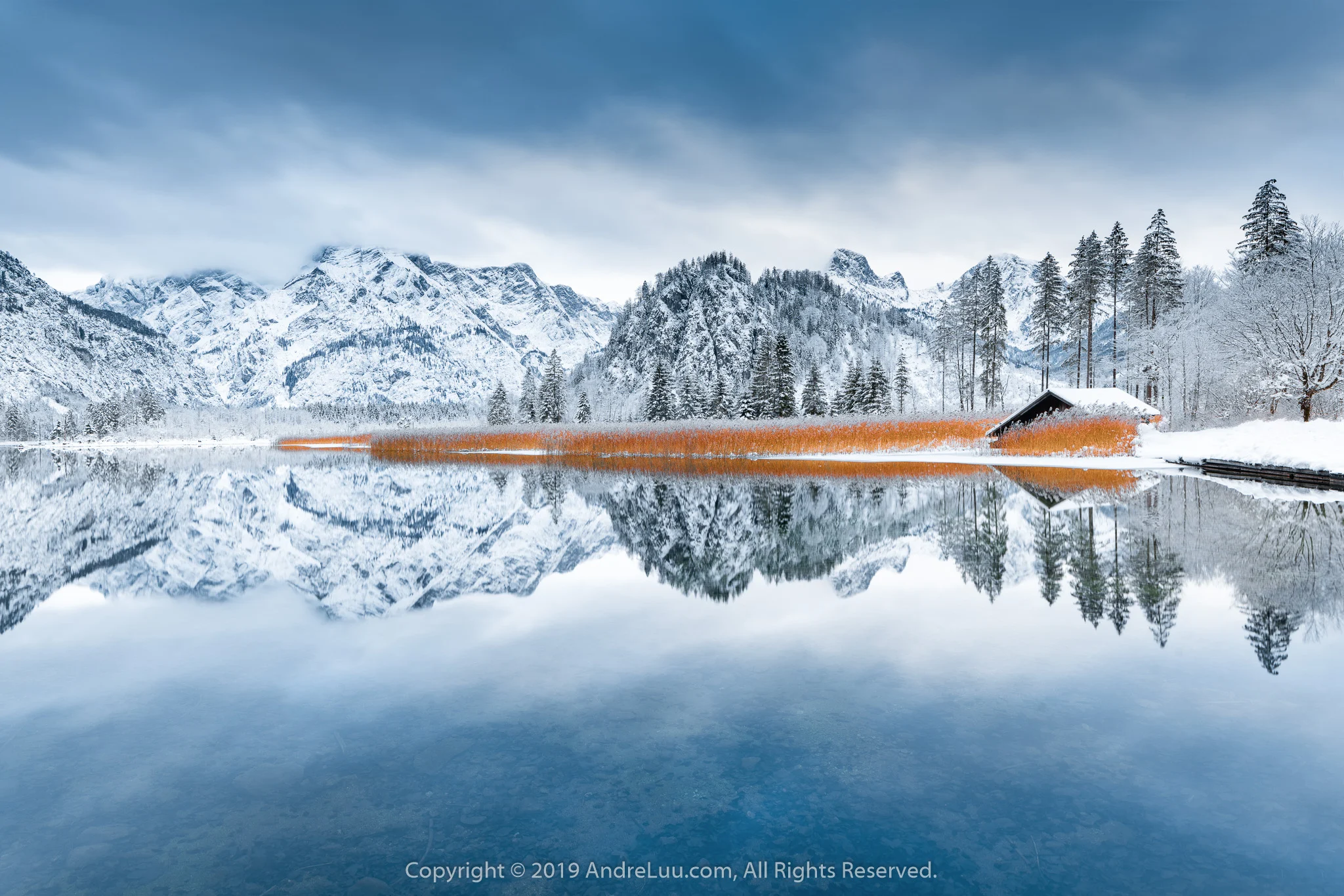
- Technique: Mirror reflections
- Place: Austria
- Lens: Sony FE 12-24 f4
See also
- Composition part 1: the photographer’s “8 brushes” (in Vietnamese)
- Composition part 2: the subject and 7 criteria of beauty (in Vietnamese)
- Composition part 3: the foreground – 13 leading lines and 5 criteria of appeal (in Vietnamese)
- Composition part 4: basic ratios – the golden ratio
After the 4 basic composition guides above, the composition knowledge that follows becomes more refined: it adapts to the conditions nature offers and emphasizes a meaning of your own that you want to express.
The symmetrical 1/2 ratio
Symmetry is one of the beauties found in nature: on a human face, for example, the features are arranged symmetrically on either side of the vertical axis (the vertical line through the bridge of the nose). If any one of the features on the face is not symmetrical, the whole face loses its beauty: one eye bigger than the other, two eyebrows that don’t match, a crooked mouth, a crooked nose… Symmetry is one of the most basic factors in creating a sense of beauty in a subject.
In this symmetrical 1/2 ratio, the subject (or group of subjects) is aligned to the center of the frame along the vertical axis or the horizontal axis.
Normally, placing the subject in the center makes most photos look very boring, except with mirror reflections or perfect symmetry, because in a mirror reflection the details are doubled, or perfectly symmetrical, which turns ordinary shapes (when there is only one half) into something interesting with a new geometry, and beautiful details become even more beautiful when they are doubled into a larger beautiful area. The principle is simple: add what is beautiful to the frame, and remove what is not, or what distracts.
A subject that is both interesting and beautiful, placed at the center of the photo at a 1/2 ratio, becomes more important and draws the viewer’s eye even more.
A simple way to apply it is to align the subject with things in nature that can reflect, such as the surface of puddles, ponds and still lakes (when there is little or no wind), and other non-natural surfaces such as flat glass, or glossy flat surfaces like the gloss paint on a car roof…
Here are some real examples:
Symmetry along the vertical axis
These interior lines (Novotel Phu Quoc hotel) are already symmetrical on both sides; therefore, they are very well suited to a 1/2 ratio along the vertical axis.

Symmetry along the horizontal axis – doubling details
The still water of this autumn lake at the end of the day is a perfect mirror for doubling the details of the rows of trees above, forming one large geometric mass. The edges of the trees, lit by the sunset light, look like half a bow; because they are reflected, they become a full bow with a much stronger visual effect.

Symmetry along the horizontal axis – doubling the light
Beautiful light becomes even more beautiful when it is doubled. The fiery red streaks of cloud in the photo are reflected in the still winter lake, forming the shape of a fork. Placed at a 1/2 ratio, they become the single focal point and gain even more power, creating a stirring, majestic feeling.

Symmetry along the horizontal axis – partial reflection
The 1/2 ratio focuses mainly on mirrored geometry to create a special visual effect, and that symmetry does not have to be as sharp as the original half. The different degrees of blur and sharpness between the two symmetrical halves give each half its own atmosphere, which is also interesting; however, it should not be too blurred, because the reflection effect will be lost, along with the special feeling of this type of composition.

The balanced 1/2 ratio
In many cases, a scene may not be perfectly symmetrical, but if its shapes and the density of its details look fairly balanced, you can still use the 1/2 ratio effectively.
You have to look with your own eyes and judge both sides (left and right, top and bottom, or both axes) to decide whether the scene can be aligned to a beautiful 1/2 composition. Or you can try several different compositions during a scouting visit, before deciding on the main composition for the frame when you return for the best light.
Balance along both axes
The cloud streaks reflected on the water create a strong balanced effect; therefore, they suit a 1/2 ratio right at the center of both axes. Most converging lines suit a 1/2 ratio composition along one axis or both axes, depending on the case.

Balance along the vertical axis
The sand patterns create a strong effect, giving both sides a sense of balance, even though the two rock masses and the clouds are not very balanced.

Balancing 2 elements along 2 different axes
The mountains in the background are reflected in the water and are symmetrical along the vertical axis. This is a type of 1/2 ratio combined with rocks in the foreground, placed to balance the gap in the mountains above.

This article is for general education and is provided "as is". Photography outdoors carries risk: you are responsible for your own safety, gear and decisions. Disclaimer
Fine art prints
Signed, made to order on archival fine art paper, with the facts behind every photograph.
See the prints
Photo trips with Andre
Small groups to Lofoten, Iceland and Vietnam, at the right season and the right hour.
Ask about the next trips