Composition part 3: foreground, 13 leading lines and 5 standards for drawing attention

Further reading
- Composition part 1: the photographer’s “8 brushes”
- Composition part 2: the subject and 7 standards of beauty
- Composition part 4: basic ratios and the golden ratio
- Composition part 5: the 1/2 ratio, symmetry and balance
Space in a landscape photo
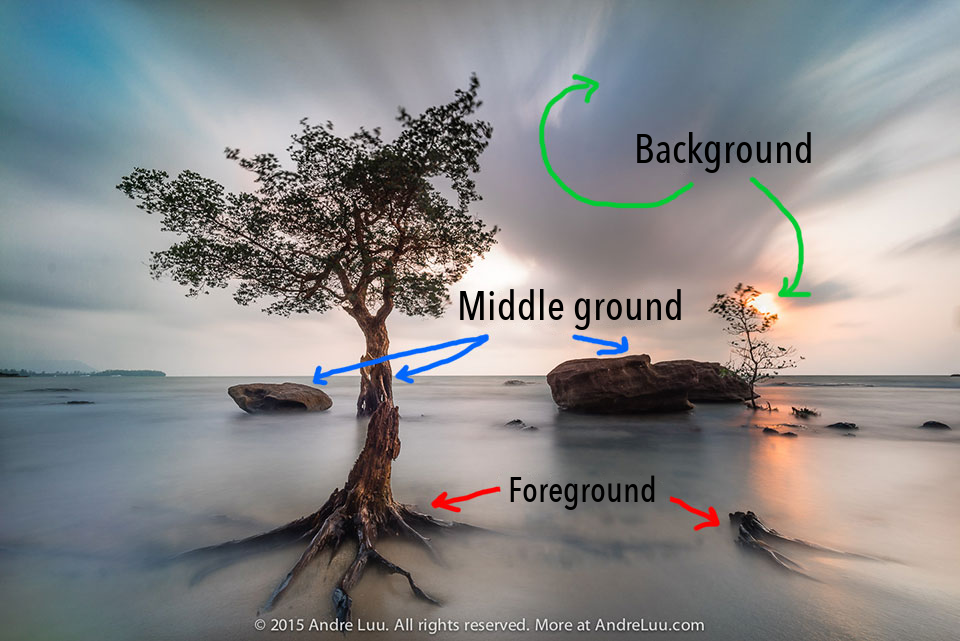
A full landscape photo can be divided into these parts:
- The foreground is the part closest to the viewer. It shows the viewer the clearest detail and therefore has the strongest effect on the eye.
- The middle ground is the part behind the foreground. Because it is farther away, it shows far less detail: mostly masses of softer, hazier shapes that have less effect on the eye.
- The background is the farthest part and the most basic backdrop of the photo, usually the sky, the sea or the distant horizon. Although it is far away, it covers the largest area of the photo, and when there are many clouds it also plays a very important part.
The foreground: creating a sense of depth for the middle ground and background
With current technology, a photo is a flat, two-dimensional (2D) space. To give it a sense of depth, the feeling of three dimensions (3D), you need a foreground, the part in front of the middle ground, to create a contrast between near and far. That contrast makes your photo feel deeper, more realistic and more engaging.

Leading lines: a foreground that points and connects
Leading lines are foreground elements that point, directly or indirectly, into the photo, drawing more attention to the middle ground or the background. When many lines run from the edges of the photo toward a single point inside it, the effect is even more powerful.
Leading lines can also connect the objects in the photo. This allows the elements to relate to one another in a more meaningful way, which in turn makes the composition simpler. Because of this strong visual effect, leading lines are very valuable in landscape photography.
13 leading lines you can frame in your composition
Here are the types of leading lines you can find or create for your photos.
1. Converging leading lines
This is the strongest type of leading line, because many strong, straight lines meet at one point and draw all of the viewer’s attention there.
This photo has converging leading lines created by the effect of a 15mm ultra-wide lens.

Sony A7R + Sony 10-18mm crop lens.
2. Straight leading line
When the line is thick enough, it can be a very strong leading line, second only to the converging leading lines above.
This photo has a crack in the moss-covered rock as its leading line. It leads into the center of the photo, where the colorful glow in the clouds is the stopping point.

3. Horizontal leading line
This photo has rice terraces as its leading line. They lead to the left and are anchored by the round shape of the last terrace.

4. Diagonal leading line
This photo has a raised earthen path as its leading line. It runs diagonally toward the right and is anchored by the subject, a tree with the sun as its focal point.

5. Curved leading line
This photo has a mountain slope as its leading line. It leads to the left and is anchored by the lone tree, which is also the subject of the photo.

6. S-curve leading line
This photo has the curving edge of a river of clouds as its leading line. It winds through the valley to the sun, which is the focal point of the photo.

7. V-shaped leading line
This photo has mountain slopes that fall and rise in V shapes. The last V “holds” a small cluster of trees, which is also the anchor point of the photo.

8. Straight implied leading line
This photo has a branch lying in the water that points toward the lone tree. It is an indirect leading line.

9. Arc implied leading line (projectile)
This photo has a rock that points up toward the sky. Because the sun is round, however, you can imagine a dragon’s head spitting out a fire pearl that falls in an arc to where the sun is.

10. Long-exposure cloud leading lines
This photo has many moving clouds forming streaks that lead into the gap between the rocks, which are the main subjects.

11. Long-exposure water leading lines
This photo has a receding wave forming streaks. They are leading lines that converge on the rising sun.

12. Light ray leading lines
This photo has light rays shining down as if to light up the pools in the rock.

13. Lens flare leading lines
This photo has colorful orbs of light created by lens flare. They form leading lines that converge on the sun, which is also the anchor point of the photo.

5 standards for drawing attention
You should apply at least one of the following 5 standards to your chosen leading lines to maximize their effectiveness in your photo.
1. Lead into the photo
At the basic level, you want the leading line to lead into the photo, so that the viewer is not distracted and spends more time exploring the details of your photo. This is the first step toward a sense of beauty. In my experience, the longer a photo can hold attention, the more beautiful it feels.
This photo has ridges of rock and a long rock mass in the distance that all point into the inner part of the photo.

2. Lead to a bright point or an interesting detail
Once your leading lines enter the photo, direct them, whenever you can, toward a subject, an interesting detail, or a bright point or bright area. The viewer’s eye then has something engaging to rest on. The more appealing that detail is, the longer you will keep the viewer’s eye in the photo.
This photo has the bamboo poles of a lift net as its leading lines, and they lead to the sun. The bamboo jetty in the lower left corner also points toward the sun, which creates unity. The net below “catches” the sun as a reflection, which makes the photo more original.

This photo has a raised earthen path as its leading line. It leads to a bare tree with a fascinating shape, like a pair of deer antlers.

3. Lead to a point of convergence
In nature, the elements of a scene rarely converge on one point; convergence usually comes from the effect of an ultra-wide lens. When a scene has many parallel lines, an ultra-wide lens makes them converge on one point.
A long exposure (usually over 1 minute) also turns moving clouds into streaks, adding leading lines in the sky. Water forms streaks in the same way. Each time a wave moves in and recedes, an exposure of about 1–3 seconds captures streaks of water that converge on the center of the photo, far in the distance.
This photo has a ridge of rock in the middle of the tide pool that points toward the rocky outcrop in the middle ground. At the same time, the long exposure turns the clouds into streaks across the last light rays of the day, and they converge on the same spot. Together, these lines meet at the center of the outcrop.

4. Lead to a stopping point
Some leading lines are long and lead out of the photo. In this case, you need a detail that stops the eye from moving out of the photo. The best detail for this is the subject or the focal point.
This photo has the boundary between the yellow rice and the green plants as its leading line. It runs diagonally to the right, heading out of the photo. The tree stands there; it is also the subject, and it stops the viewer’s eye. Together with the small cloud in the sky, it keeps the viewer’s eye in the photo.

This photo has a main leading line that is also the subject. It runs from the right of the frame to the left and heads out of the photo, but the cluster of details on the near hill and the pointed tree that juts out keep the viewer’s eye in the photo.

5. Unity
The most important principle is unity among the leading lines. If a photo has more than one leading line, all of them should lead to the same destination, such as the point of convergence, the subject or the focal point described above.
You should pay attention not only to direct leading lines but also to implied ones. The direction in which they point should also lead to the same destination as the other leading lines. When the leading lines do not converge, they should at least point in the same direction.
When you achieve this, all the leading lines work together in harmony and unity. That creates order, and order makes your photo more beautiful.
This unified photo has many leading lines: the ridges of moss-covered rock and the pink streak of cloud. All of them point to the rock mass, which creates unity.

Sony a7R + Voigtlander 12.
This photo lacks unity: it has leading lines in 2 different directions. One is the rock ridges that converge toward the left; the other is the channel of water that points toward the tree in the distance. However, this second line is not strong enough to create a clear sense of 2 directions.

Further reading
This article is for general education and is provided "as is". Photography outdoors carries risk: you are responsible for your own safety, gear and decisions. Disclaimer
Fine art prints
Signed, made to order on archival fine art paper, with the facts behind every photograph.
See the prints
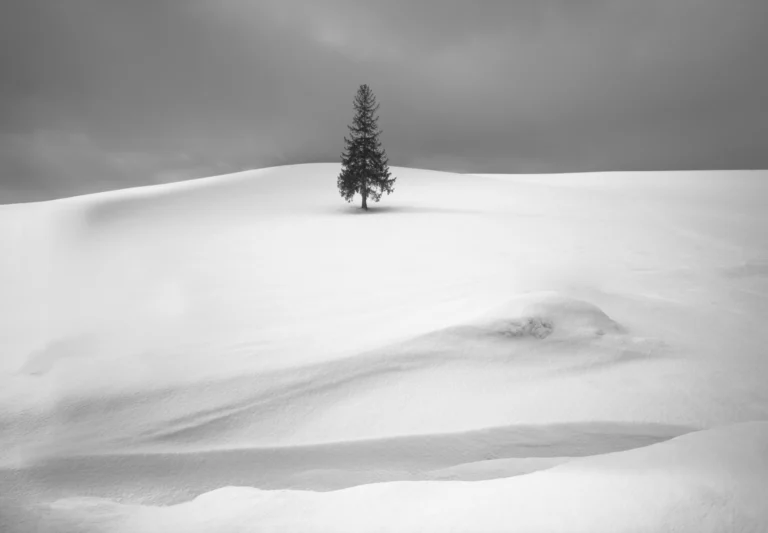
Photo trips with Andre
Small groups to Lofoten, Iceland and Vietnam, at the right season and the right hour.
Ask about the next trips